


Franchise vs Licensing In Africa is becoming one of the biggest business expansion conversations heading into 2027. Across Nigeria, Kenya, South Africa, Ghana, Rwanda, and other fast-growing African economies, entrepreneurs are searching for business systems that can scale profitably without creating operational chaos.
Some founders want complete control over branding and customer experience. Others want faster expansion with lower startup costs and fewer management responsibilities.
That is exactly where franchising and licensing come in.
While both business models help companies expand, they work very differently. One focuses heavily on operational structure and consistency. The other focuses more on intellectual property and flexibility.
The truth is simple:
Neither franchising nor licensing is automatically more profitable.
The better option depends on:
- Your business type
- Your operational capacity
- Your expansion goals
- Your capital
- Your legal structure
- Your long-term strategy
According to the World Bank, Africa’s entrepreneurial ecosystem continues expanding due to urbanization, mobile internet adoption, digital payments, and growing regional trade.
At the same time, the African Continental Free Trade Area (AfCFTA) is encouraging more businesses to think beyond operating in a single country.
As a result, more African entrepreneurs are now evaluating Franchise vs Licensing In Africa as a serious long-term growth strategy.
What Is Franchise vs Licensing In Africa?
Understanding Franchise vs Licensing In Africa starts with understanding how both models work independently.
What Is Franchising?
Franchising is a business structure where a company allows another entrepreneur to operate using its:
- Brand name
- Operational systems
- Marketing processes
- Training methods
- Supplier relationships
- Business model
The business owner granting the rights is called the franchisor, while the local operator is called the franchisee.
In exchange, the franchisee usually pays:
- An initial franchise fee
- Monthly royalty payments
- Marketing contributions
Global companies like McDonald’s, KFC, and Subway expanded globally using franchise systems.
Across Africa, franchising is now growing rapidly in:
- Fast food
- Retail stores
- Fitness businesses
- Beauty salons
- Healthcare services
- Education centers
- Logistics companies
What Is Licensing?
Licensing works differently.
Instead of handing over complete operational systems, the company allows another business to use specific intellectual property.
This may include:
- Software
- Technology
- Trademarks
- Recipes
- Media content
- Product formulas
- Digital systems
The licensee pays fees or royalties for permission to use those assets.
Unlike franchising, licensing usually involves less operational control.
Why Franchise vs Licensing In Africa Is Growing Fast
The rise of Franchise vs Licensing In Africa is connected directly to changing economic trends.
Several major factors are driving this growth:
- Rapid urbanization
- Growing youth entrepreneurship
- Digital commerce expansion
- Cross-border trade opportunities
- Mobile payment adoption
- Regional business integration
Many founders no longer want businesses limited to one city or country.
They want systems that can expand regionally.
This is especially important under AfCFTA frameworks, where businesses are increasingly exploring regional operations across multiple African markets.
Related reading: Operate Business Across Africa AfCFTA (No Need for Multiple Registrations in 2026)
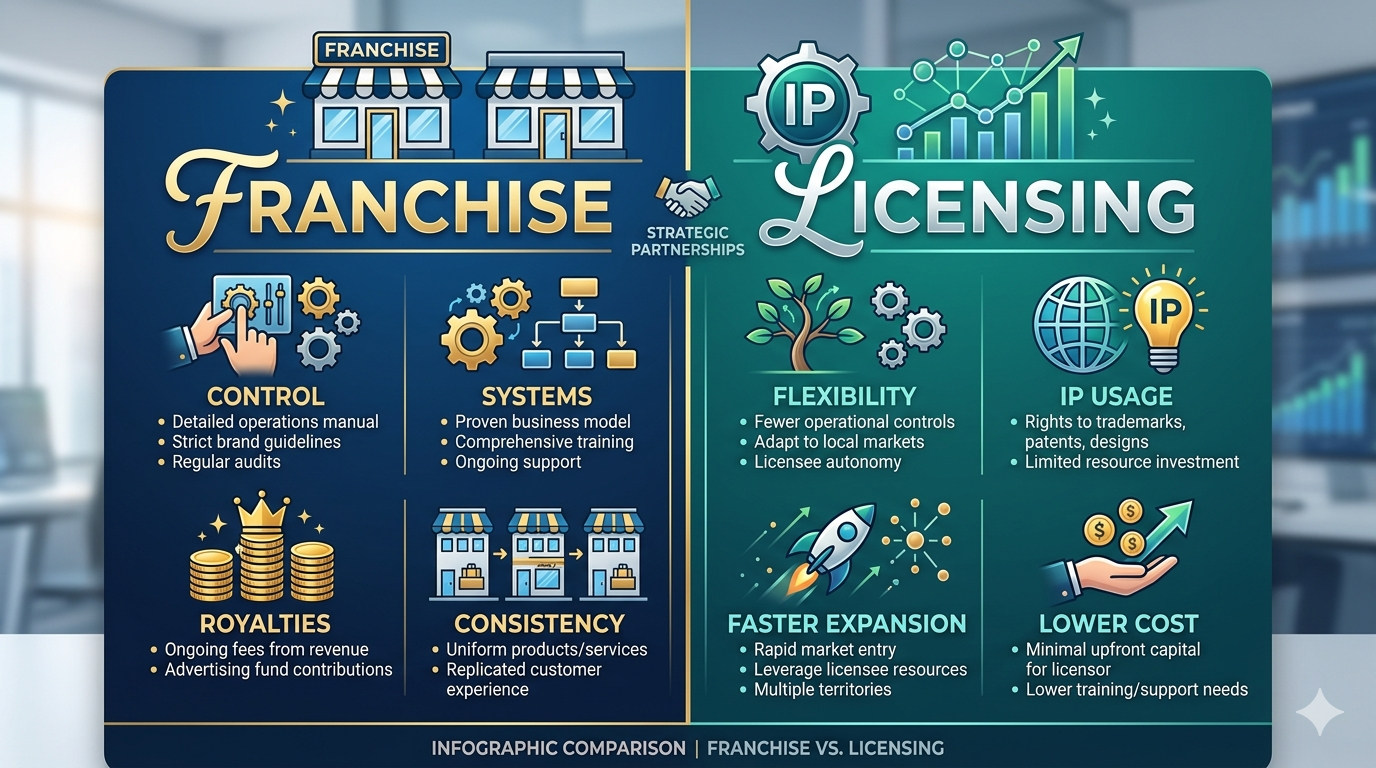
Major Differences In Franchise vs Licensing In Africa
| Factor | Franchise | Licensing |
|---|---|---|
| Operational Control | High | Lower |
| Expansion Speed | Moderate | Faster |
| Startup Cost | Higher | Lower |
| Brand Consistency | Stronger | Variable |
| Flexibility | Limited | Higher |
Which Is More Profitable In Franchise vs Licensing In Africa?
When discussing Franchise vs Licensing In Africa, profitability depends heavily on execution.
There are successful franchise businesses generating millions in annual revenue. There are also profitable licensing businesses scaling rapidly across multiple countries.
However, both systems have advantages and limitations.
Franchising Is Usually More Profitable When:
- Customer experience matters heavily
- Brand consistency affects sales
- Operational systems drive success
- Training quality matters
- The business relies on trust
Industries where franchising performs strongly include:
- Restaurants
- Hotels
- Fitness centers
- Healthcare businesses
- Education services

Licensing Is Usually More Profitable When:
- Fast expansion matters more
- Intellectual property is valuable
- Local adaptation is important
- Digital products drive revenue
- Lower management involvement is preferred
Licensing works especially well in:
- Software
- Digital platforms
- Beauty products
- Media businesses
- Fashion brands
- Educational content
Realistic Expectations For Entrepreneurs
One major mistake many entrepreneurs make is expecting instant financial success.
That rarely happens.
Both franchising and licensing require:
- Strong management
- Financial discipline
- Operational planning
- Legal protection
- Customer acquisition
- Long-term consistency
Small beginner business opportunities may help entrepreneurs learn skills and generate modest income, but sustainable wealth usually comes from building scalable systems.
That growth path often looks like this:
Learning → Small Opportunities → Building Systems → Creating Assets → Scaling Revenue
The Hidden Costs Most Founders Ignore
One reason businesses fail is inaccurate profit calculation.
Many entrepreneurs calculate only:
- Sales revenue
- Basic expenses
- Inventory costs
But African businesses also face:
- Foreign exchange fluctuations
- Import duties
- Fuel costs
- Infrastructure expenses
- Internet and power costs
- Regulatory compliance
- Cross-border logistics
Ignoring these hidden costs can destroy profitability.
Related reading: How to Calculate Business Profit in Africa (Including Hidden Costs, FX & Logistics 2026)
Legal Agreements Can Make Or Break The Business
Strong contracts are essential in Franchise vs Licensing In Africa.
Without proper agreements, businesses may face:
- Brand misuse
- Revenue disputes
- Territory conflicts
- Supplier disagreements
- Intellectual property theft
- Partnership breakdowns
Every agreement should clearly define:
- Rights and responsibilities
- Territory limitations
- Payment structures
- Termination rules
- Brand usage guidelines
- Dispute resolution systems
Businesses working with suppliers should also understand proper contract structures.
Related reading: Supplier Contract In Nigeria (What Every Business Must Include in 2026 Agreements)
Tax Compliance Is Becoming More Important
As African governments improve digital tax systems, compliance matters more than ever.
Businesses operating franchise or licensing systems may encounter:
- Corporate taxes
- VAT obligations
- Royalty taxation
- Withholding tax
- Cross-border compliance rules
Entrepreneurs operating in Nigeria should stay updated with recent compliance changes.
Related reading: FIRS Tax Rules in Nigeria Small Business (2026–2027 Important Compliance Update)
Why Some African Startups Still Collapse
Funding alone does not guarantee success.
Many startups across Africa still fail because they:
- Scale too aggressively
- Ignore operational systems
- Mismanage finances
- Depend heavily on investors
- Lack sustainable revenue models
According to the International Finance Corporation (IFC), operational discipline and governance systems are critical for long-term business sustainability.
Related reading: Startup Accelerator Failure In Africa 2027 (Why Funded Startups Still Collapse)
The Bigger Opportunity: Building Scalable Digital Assets
One major trend changing Franchise vs Licensing In Africa is digital business growth.
Many entrepreneurs are now combining traditional business models with scalable online systems.
This includes building:
- Websites and blogs
- YouTube channels
- Mobile apps
- Online communities
- E-commerce systems
- Educational platforms
These digital assets can generate:
- Advertising revenue
- Affiliate commissions
- Subscription income
- Lead generation
- Recurring customer relationships
Research from UNCTAD continues showing how digital infrastructure is reshaping growth opportunities across emerging markets.
Teams like Valspill increasingly help businesses build these scalable systems properly for long-term monetization and regional growth.
How To Choose Between Franchise And Licensing
Choose Franchising If:
- You need operational control
- Your business depends on customer consistency
- You can provide training systems
- You want stronger brand protection
- You can manage supervision effectively
Choose Licensing If:
- You want faster expansion
- You own valuable intellectual property
- You prefer lower operational involvement
- You want regional flexibility
- Your business is digital or product-based

Future Trends Shaping Franchise vs Licensing In Africa
Several trends are shaping the future of Franchise vs Licensing In Africa:
- AI-powered customer systems
- Cross-border digital commerce
- Cloud-based business operations
- Regional logistics networks
- Mobile-first payment ecosystems
- Digital franchise management systems
- Localized manufacturing partnerships
Businesses that combine operational structure with digital scalability may gain the strongest long-term advantage.
Final Thoughts On Franchise vs Licensing In Africa
Franchise vs Licensing In Africa is not about choosing a universally “better” business model.
It is about choosing the structure that fits your business goals, resources, operational strength, and long-term strategy.
Franchising usually provides stronger brand consistency and operational control.
Licensing often provides faster expansion with lower management complexity.
Both models can become profitable when supported by:
- Strong systems
- Proper legal agreements
- Financial discipline
- Scalable digital infrastructure
- Long-term strategic planning
In 2027, African entrepreneurs who combine traditional business systems with scalable digital assets may position themselves for stronger and more sustainable growth over time.
Frequently Asked Questions (FAQ)
What is the difference between franchise and licensing?
Franchising involves a complete business system with operational support and brand control, while licensing mainly grants permission to use intellectual property.
Which is cheaper to start?
Licensing is usually cheaper because it involves lower operational requirements and less management oversight.
Is franchising growing in Africa?
Yes. Franchising is expanding rapidly across food, retail, healthcare, logistics, and education sectors.
Can digital businesses use licensing?
Absolutely. Software, apps, digital platforms, and educational content businesses commonly use licensing systems.
Why do some franchise businesses fail?
Poor management, weak operational systems, inaccurate financial planning, and rapid expansion are common reasons.
Can beginners eventually scale small opportunities into large businesses?
Yes. Many entrepreneurs start small, learn valuable skills, build systems, and gradually create scalable digital or operational assets over time.