


That is why a properly drafted business profit sharing agreement is no longer optional in Nigeria’s modern business environment. It protects everyone involved, reduces future disputes, and gives investors more confidence in the partnership structure.
Whether you are building a startup, opening a family business, launching an online platform, running a cooperative venture, or creating a joint investment project, understanding the right legal clauses in Business Profit Sharing Agreements in Nigeria can save your business from expensive conflicts later.
Why Business Profit Sharing Agreements in Nigeria Matter More in 2027
Nigeria’s business environment is becoming more competitive and compliance-driven. Investors, lenders, and even international partners now pay close attention to legal structure before committing funds.
A simple verbal agreement that worked in small businesses years ago is now considered risky. In 2027, partnerships without written contracts often face:
- Profit disputes
- Unclear ownership structures
- Tax complications
- Regulatory compliance issues
- Investor distrust
- Court battles
- Operational confusion
According to guidance from the Corporate Affairs Commission (CAC) and commercial legal practitioners, documented partnership terms significantly reduce disputes among founders and investors.
This also connects closely with business scalability. Many startups fail because they cannot transition from informal arrangements into structured companies. If you want to understand why scalability matters to investors, read this related guide on Scalable Business Definition Investors 2026: Why Most Startups Fail Scalability Tests Before Profit.
What Is a Business Profit Sharing Agreement in Nigeria?
A business profit sharing agreement is a legal document that explains how profits, losses, expenses, responsibilities, and ownership interests will be divided among partners in a business.
It acts as a roadmap for the financial relationship between all parties involved.
In Nigeria, this agreement may exist between:
- Co-founders of startups
- Family business partners
- Investors and operators
- Joint venture companies
- Creative partnerships
- Agricultural cooperatives
- Import/export businesses
- Digital business collaborations
Essential Legal Clauses Every Business Profit Sharing Agreement in Nigeria Must Include
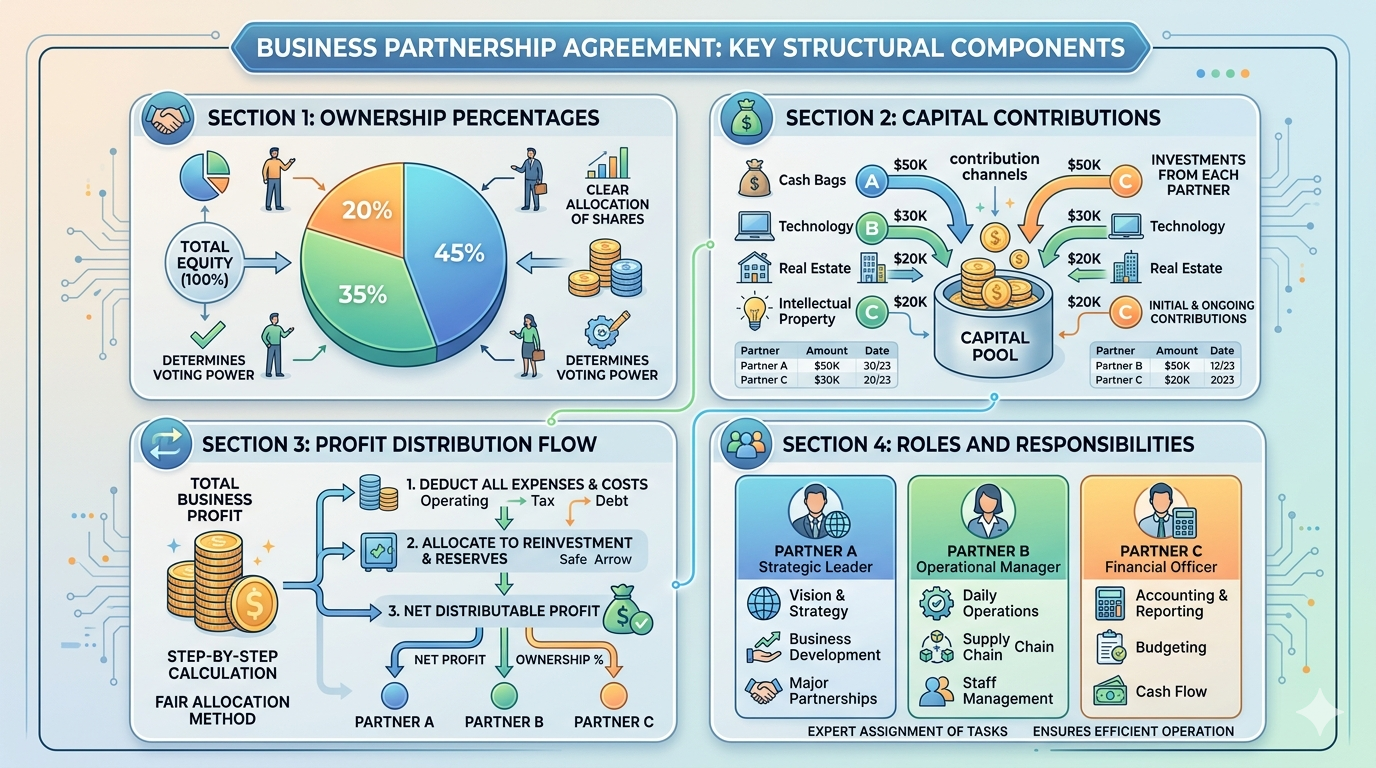
Every professionally drafted Business Profit Sharing Agreement in Nigeria should clearly define ownership, profit distribution, operational authority, dispute resolution, taxation responsibilities, and exit procedures. Without these protections, partnerships can quickly become unstable as revenue grows.
1. Ownership Structure Clause
This section clearly defines who owns what percentage of the business.
Many partnerships fail because founders assume ownership should automatically remain equal forever. But business contributions change over time.
For example:
- One partner may provide capital
- Another may contribute technical skills
- Another may handle daily operations
- Another may provide industry connections
A proper agreement should define:
- Percentage ownership
- Voting rights
- Equity dilution rules
- Future investment impact
- Ownership transfer conditions
Example:
A Lagos-based logistics startup started with three partners. One founder contributed ₦12 million in capital, another built the technology platform, while the third managed operations across Abuja and Port Harcourt. Instead of dividing ownership equally, they structured ownership based on measurable value contribution and future responsibilities.
This reduced future disagreements when the business later attracted outside investors.
2. Profit Distribution Formula
This is the heart of the agreement.
The contract must explain:
- How profits are calculated
- When profits are distributed
- What expenses are deducted first
- Whether profits are reinvested
- Emergency reserve policies
Many Nigerian businesses make the mistake of sharing revenue instead of actual profit. This creates cash flow problems very quickly.
A safer structure is:
- Revenue enters company account
- Operational costs are deducted
- Taxes are accounted for
- Emergency reserves are maintained
- Remaining profit is distributed based on agreed percentages
This approach protects the sustainability of the business.
3. Roles and Responsibilities Clause
One of the biggest causes of partnership conflict in Nigeria is unclear responsibilities.
Some partners assume everyone should “naturally know” their duties. Unfortunately, that rarely works in real business situations.
The agreement should specify:
- Who manages operations
- Who handles finances
- Who approves spending
- Who supervises staff
- Who manages compliance
- Who represents the business legally
This becomes especially important as businesses grow beyond startup level.
If you are transitioning from employment into entrepreneurship, understanding operational structure is critical. You may also find this helpful: Smart Full-Time Business Ownership in Nigeria (2027 Guide to Leaving Salary Employment Safely).
4. Capital Contribution Clause
This section outlines how much each partner contributes financially or materially.
It should include:
- Initial capital contributions
- Additional funding obligations
- Asset contributions
- Equipment ownership
- Intellectual property contributions
For example, if one partner contributes software, vehicles, land, or equipment, the agreement should state whether those assets remain personal property or become company property.
5. Exit and Withdrawal Clause
Businesses evolve. Partners relocate, lose interest, retire, or pursue new opportunities.
A strong agreement prepares for these situations early.
The contract should define:
- How partners can exit
- Notice periods
- Buyout formulas
- Share valuation methods
- Restrictions after leaving
Without this clause, businesses often experience destructive legal battles.
One Abuja media agency reportedly lost a major investor deal because two founders disagreed on how a departing partner’s shares should be valued. The disagreement delayed negotiations for almost nine months.
6. Dispute Resolution Clause
Even healthy partnerships can experience disagreements.
Instead of immediately going to court, many businesses now prefer:
- Mediation
- Arbitration
- Internal resolution procedures
This clause should explain:
- How disputes are reported
- Who mediates conflicts
- Which courts have jurisdiction
- Arbitration procedures
Nigerian commercial litigation can be expensive and time-consuming. Alternative dispute resolution methods are often faster and more affordable. Businesses also increasingly reference frameworks from organizations like the World Bank and the Doing Business project when studying investment environments and governance systems.
7. Tax and Compliance Responsibilities
Tax compliance is becoming stricter in Nigeria.
Partnership agreements should clearly define:
- Who handles tax filings
- Accounting responsibilities
- CAC compliance duties
- Annual filing obligations
- Audit procedures
Many businesses underestimate how important regulatory compliance has become in 2027.
Failure to maintain proper filings can lead to penalties, reputational damage, or investor concerns.
To better understand current filing obligations, read this detailed resource on Essential CAC Annual Return Filing in Nigeria 2027: Costs, Penalties, Deadlines and Compliance Guide.
8. Confidentiality and Non-Compete Clauses
Modern businesses depend heavily on intellectual property, customer databases, operational systems, and proprietary strategies.
The agreement should protect:
- Business secrets
- Client data
- Supplier relationships
- Marketing strategies
- Technology systems
A non-compete clause may also restrict partners from launching competing businesses immediately after exiting the partnership.
However, these clauses must remain legally reasonable to avoid enforceability problems.
9. Decision-Making and Voting Rights
Not every business decision should require unanimous approval.
The agreement should explain:
- Routine operational authority
- Major financial approval thresholds
- Voting structures
- Emergency decision authority
- Investor voting protections
For instance, a business may allow operational managers to approve expenses below ₦500,000, while larger financial commitments require partner approval.
10. Profit Reinvestment Policy
One overlooked issue in Nigerian partnerships is balancing personal withdrawals with business growth.
Some partners want immediate income distributions, while others prefer reinvesting profits.
The agreement should define:
- Minimum retained earnings
- Reinvestment percentages
- Dividend schedules
- Expansion funding rules
This becomes extremely important in industries with high growth potential.
How Poor Business Profit Sharing Agreements in Nigeria Destroy Businesses
Many startup collapses across Africa are linked to partnership conflicts rather than weak products.
In fact, founder disputes remain one of the most common reasons investors avoid early-stage businesses.
A practical example occurred in a Nigerian fintech collaboration where two founders disagreed over investor equity allocation after external funding arrived. Since their original agreement lacked dilution clauses, the relationship deteriorated rapidly and the company eventually split into separate businesses.
This broader issue is also explored in this article on Startup Accelerator Failure In Africa 2027 (Why Funded Startups Still Collapse).

Common Mistakes Entrepreneurs Make
- Using generic online templates without legal review
- Relying only on verbal agreements
- Ignoring tax implications
- Failing to define exit terms
- Mixing personal and business finances
- Not documenting capital contributions
- Leaving profit calculations vague
These mistakes may appear small initially, but they become dangerous as the business grows.
The Role of Lawyers and Professional Advisors
Although some small partnerships try to avoid legal costs, professional drafting often saves significantly more money long term.
A qualified commercial lawyer can help:
- Ensure compliance with Nigerian law
- Protect intellectual property
- Structure ownership properly
- Reduce loopholes
- Prepare for future investors
Professional accountants also play an important role in structuring sustainable profit allocation systems.
How Digital Businesses Are Changing Partnership Structures
In 2027, more Nigerian entrepreneurs are building digital-first businesses including:
- Content platforms
- Online education brands
- SaaS products
- E-commerce operations
- YouTube media channels
- Mobile applications
These businesses often scale faster than traditional offline ventures, which makes strong legal agreements even more important.
Many young entrepreneurs start with small online earning opportunities like freelance work, affiliate marketing, or content creation. While these can provide useful starting income, sustainable wealth usually comes from building scalable digital assets over time.
For example:
- A freelancer may eventually build an agency
- A blogger may launch multiple monetized websites
- A content creator may build a full media brand
- A small app developer may scale into SaaS products
This gradual progression from small income streams to scalable systems is how many successful digital entrepreneurs grow sustainably.
Teams like Valspill increasingly help businesses develop structured digital assets correctly for monetization, scalability, and long-term operational growth rather than relying only on temporary online income methods.

Understanding Business Culture Before Partnership Agreements
Foreign investors entering Nigeria sometimes underestimate how important local business culture can be during negotiations.
Communication styles, relationship building, negotiation pace, trust expectations, and hierarchy structures all influence partnership dynamics.
This is why understanding local commercial behavior is critical before signing agreements.
For deeper insights, read Nigerian Business Culture in 2026/2027: 23 Rules Foreign Investors Must Understand Before Signing Deals.
Why Pricing Strategy Also Impacts Profit Sharing
Profitability depends heavily on pricing systems.
If a business underprices products or services, partnership disputes can emerge because actual profits remain lower than expected.
Modern Nigerian businesses now pay closer attention to:
- Inflation adjustments
- Currency fluctuations
- Operational cost increases
- Competitive market pressure
- Customer retention strategies
Understanding sustainable pricing is critical for healthy long-term partnerships. This related guide explains more: Product Pricing Strategy In Africa (How to Stay Profitable in 2027 Competitive Markets).
Should Small Businesses Use Formal Agreements?
Yes.
Even very small businesses benefit from proper documentation.
A simple but professionally structured agreement can prevent future emotional and financial damage.
In fact, smaller businesses are often more vulnerable because personal relationships become deeply connected to financial expectations.
Practical Checklist Before Signing Any Partnership Agreement
- Verify all partner identities
- Confirm ownership percentages clearly
- Document all financial contributions
- Review tax obligations
- Define operational authority
- Create clear dispute procedures
- Include exit mechanisms
- Review compliance responsibilities
- Consult legal professionals
- Store signed copies securely
The Future of Business Profit Sharing Agreements in Nigeria
Experts expect Business Profit Sharing Agreements in Nigeria to become even more sophisticated as investors demand stronger governance, transparency, and legal accountability from modern businesses.
As Nigeria’s entrepreneurial ecosystem continues evolving, partnership structures are becoming more sophisticated.
Investors increasingly expect:
- Transparent governance systems
- Proper compliance documentation
- Clear equity structures
- Professional financial management
- Scalable operational frameworks
Businesses that ignore these realities may struggle to attract funding or scale successfully in competitive markets.
Final Thoughts On Business Profit Sharing Agreements in Nigeria
A business profit sharing agreement is far more than a legal document. In modern Business Profit Sharing Agreements in Nigeria, strong legal structure has become a foundation for trust, accountability, scalability, and long-term business stability.
In Nigeria’s fast-changing business environment, informal arrangements create unnecessary risk. Whether you are starting a traditional business, building a tech company, launching a content platform, or creating a joint investment project, clear legal agreements protect everyone involved.
Small online income opportunities may help people begin their entrepreneurial journey, but long-term financial growth usually comes from structured systems, scalable assets, and professionally managed partnerships.
The entrepreneurs who build sustainable businesses in 2027 are increasingly those who combine ambition with proper legal structure, operational clarity, realistic expectations, and scalable growth planning.
If you are considering a new partnership, this is the right time to approach it professionally from the beginning. Properly structured Business Profit Sharing Agreements in Nigeria can protect relationships, strengthen investor confidence, and create a clearer path toward sustainable business growth.
Frequently Asked Questions (FAQ) On Business Profit Sharing Agreements in Nigeria
Is a profit sharing agreement legally enforceable in Nigeria?
Yes. A properly drafted and signed agreement that complies with Nigerian commercial laws can be legally enforceable in court or arbitration proceedings.
Do small businesses need partnership agreements?
Absolutely. Even small businesses benefit from clear written agreements because disputes often arise once money, ownership, or responsibilities become unclear.
Can partnership percentages change later?
Yes. Agreements can include dilution clauses, additional investment terms, or renegotiation procedures that allow ownership adjustments over time.
What happens if a partner wants to leave the business?
A strong agreement should contain exit clauses explaining notice periods, valuation methods, and buyout procedures.
Should I hire a lawyer for a partnership agreement in Nigeria?
Yes. Professional legal drafting helps reduce loopholes, improve compliance, and protect all parties involved.
Can digital businesses use profit sharing agreements?
Yes. Digital businesses, startups, media brands, app companies, and online platforms often rely heavily on structured partnership agreements because scalability increases complexity quickly.