


WhatsApp to e-commerce store transitions are becoming one of the most important growth decisions for small businesses in Nigeria. What begins as a simple hustle managed through chats and status updates can quickly become stressful when customer orders increase, messages pile up, and business operations become difficult to control manually.
That was exactly what happened to my business.
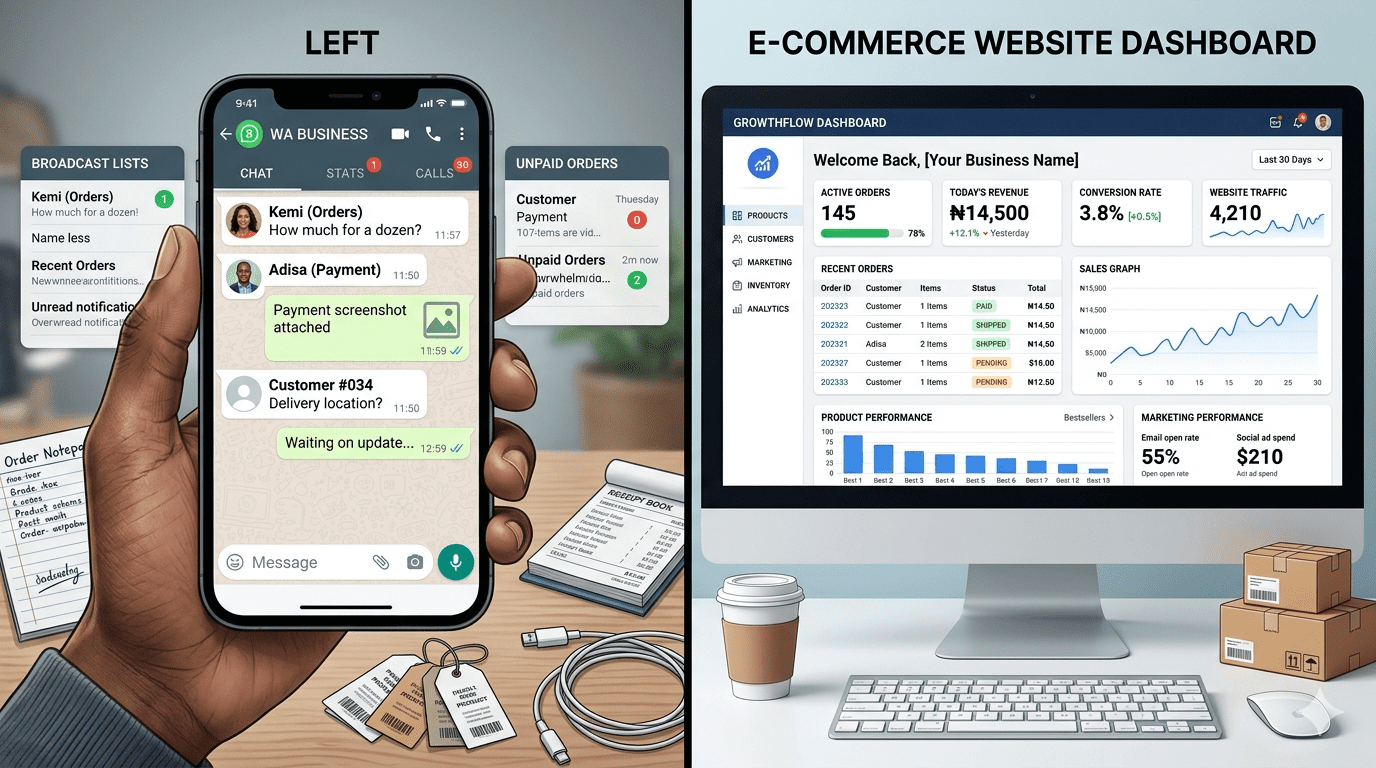
For almost two years, everything ran through WhatsApp Business. Customers sent screenshots for payments, delivery information stayed buried inside conversations, and customer support depended entirely on how quickly messages could be answered.
At first, it worked surprisingly well.
But eventually, the business started facing the same hidden problems that cause many bootstrapped businesses in Nigeria to fail before reaching year three.
The WhatsApp to e-commerce store transition completely changed how the business operated. Orders became easier to manage, customers trusted the brand more, repeat sales increased, and the business finally started feeling scalable instead of chaotic.
Most importantly, the experience revealed something many entrepreneurs eventually discover:
Hard work alone is not enough. Sustainable businesses need systems.
Why Many Small Businesses Start on WhatsApp
For most Nigerian entrepreneurs, WhatsApp is the easiest and cheapest place to begin.
You don’t need expensive software or advanced technical skills. A smartphone, internet connection, and a product are often enough to get started.
That simplicity makes WhatsApp attractive for:
- Fashion vendors
- Food businesses
- Beauty brands
- Mini importation businesses
- Freelancers
- Digital product sellers
According to Statista, mobile messaging apps remain among the most widely used digital platforms across Africa, which explains why WhatsApp-based selling has become extremely common.
For beginners, starting small makes sense.
Many entrepreneurs simply want to test whether people are willing to buy before investing heavily in websites or digital infrastructure.
When WhatsApp Started Becoming a Problem
The problems did not appear immediately.
At the beginning, handling a few customers daily felt manageable.
But once sales started increasing, the workload became overwhelming.
Some common problems started appearing regularly:
- Missed customer messages
- Late replies
- Lost payment confirmations
- Confusion with delivery addresses
- Difficulty tracking inventory
- Customer complaints caused by delays
At one point, two customer orders were accidentally mixed up because delivery details got buried inside multiple chats.
Another customer stopped buying completely after waiting several hours for a response.
That moment exposed a major reality:
The business was growing faster than the systems supporting it.
Why Many Bootstrapped Businesses Fail Before Year Three
After talking with other entrepreneurs and studying similar struggles, one pattern became obvious.
Many small businesses fail because founders remain trapped in survival mode for too long.
According to the Small and Medium Enterprises Development Agency of Nigeria (SMEDAN), common challenges affecting Nigerian businesses include:
- Poor financial management
- Weak operational systems
- Limited access to funding
- Low digital adoption
- Customer retention problems
- Founder burnout
Most business owners are not lazy.
In fact, many work extremely hard.
The problem is that hustle alone eventually reaches its limit.
The “Everything Depends on Me” Problem
Many small business owners handle:
- Customer service
- Marketing
- Payments
- Inventory
- Delivery coordination
- Social media management
all by themselves.
That setup works temporarily, but it becomes dangerous as demand increases.
Exhaustion leads to inconsistency.
And inconsistency slowly destroys customer trust.
Why the WhatsApp to E-Commerce Store Transition Matters
The WhatsApp to e-commerce store transition was not initially about becoming a huge company.
It was about reducing stress and creating structure.
The business needed:
- Automated ordering
- Better inventory tracking
- Professional branding
- Secure checkout systems
- Organized customer information
- Reduced manual workload
Eventually, a proper online store was launched with:
- Product pages
- Payment integration
- Automated checkout
- Email notifications
- Order tracking
- Mobile optimization
The results were noticeable almost immediately.
What Improved Immediately After the WhatsApp to E-Commerce Store Transition
1. Customers Trusted the Brand More
One surprising benefit of the WhatsApp to e-commerce store move was the increase in customer trust.
Even though the products remained the same, the business suddenly appeared more reliable and professional.
Customers appreciated:
- Transparent pricing
- Organized product listings
- Professional checkout pages
- Secure payment options
- Easy navigation
Several customers even commented that the business looked “more serious” after the website launched.
In Nigeria’s digital marketplace, trust matters heavily because online scams have made buyers cautious.
2. Business Operations Became Easier
Before the website, tracking sales required scrolling through chats and bank alerts manually.
After the WhatsApp to e-commerce store transition, the system automatically organized:
- Orders
- Payments
- Customer information
- Delivery records
- Sales reports
This reduced mistakes significantly and saved hours of manual work every week.
3. Repeat Customers Increased
The e-commerce store improved customer convenience.
Returning customers could:
- Reorder faster
- Save delivery details
- Browse products easily
- Receive promotions automatically
That convenience increased repeat purchases noticeably.
People naturally buy more often from businesses that save them time.
4. Social Media Marketing Became More Effective
Before the website existed, Instagram and TikTok traffic usually ended in long WhatsApp conversations.
After the WhatsApp to e-commerce store upgrade, customers could move directly from social media posts into product pages and checkout systems.
That reduced friction and improved conversion rates.

Common Mistakes During a WhatsApp to E-Commerce Store Transition
One major mistake entrepreneurs make during a WhatsApp to e-commerce store migration is trying to scale too quickly without improving customer support and delivery operations.
Another problem is assuming customers will instantly adapt to new systems.
Some buyers still prefer chatting manually before placing orders.
The smartest approach is combining both systems temporarily while customers adjust gradually.
The WhatsApp to e-commerce store process also requires patience because operational improvements usually happen step by step.
For many entrepreneurs, the WhatsApp to e-commerce store shift becomes the first real step toward building a scalable digital business instead of depending entirely on manual communication.
The Hidden Cost of Staying Too Small
Many entrepreneurs avoid building systems because they fear expenses.
Ironically, staying disorganized often becomes more expensive over time.
Hidden costs of poor systems include:
- Lost customers
- Burnout
- Slow response times
- Inventory mistakes
- Poor customer experience
- Weak brand perception
Sometimes businesses fail not because the products are bad, but because operations become too chaotic.
The Bigger Lesson About Online Income
One important lesson from this experience is that beginner online income methods usually have limits.
Platforms like WhatsApp, small online tasks, or quick side hustles can help people start earning.
But sustainable income usually comes from building scalable digital assets.
Examples include:
- Websites
- Blogs
- YouTube channels
- E-commerce stores
- Mobile apps
- Email subscriber lists
These systems continue creating opportunities long after the initial work is completed.
The Valspill team also emphasizes that properly built digital assets help businesses create more sustainable revenue systems instead of depending entirely on unstable social media algorithms.
The realistic growth path usually looks like this:
- Start small
- Learn customer behavior
- Build systems
- Scale traffic
- Expand income streams
That gradual progression is far more sustainable than chasing unrealistic “quick money” trends online.
Financial Discipline Still Matters
Even strong systems cannot fix poor financial habits.
Many businesses struggle because founders:
- Mix business and personal money
- Expand too quickly
- Ignore cash flow
- Take risky loans too early
- Price products incorrectly
If you want to understand how lenders evaluate businesses before approving funding, read this related guide:
What Banks Really Look For in a Business Loan Application (Hidden Truths Exposed)
Understanding financing decisions early can help entrepreneurs avoid expensive mistakes later.
What I Would Do Differently Today
If starting again, several things would happen earlier.
- Building a website sooner
- Learning SEO earlier
- Automating repetitive tasks
- Collecting customer emails from day one
- Tracking business data properly
- Improving branding earlier
Most importantly, there would be less focus on appearing successful and more focus on building reliable systems slowly.

Final Thoughts
The WhatsApp to e-commerce store transition completely changed how the business operated.
What once felt stressful and disorganized became more professional, scalable, and manageable.
WhatsApp is still an excellent starting point for beginners.
But businesses that survive long term usually move beyond manual systems eventually.
The entrepreneurs who survive beyond year three are often the ones quietly building:
- Systems
- Customer trust
- Digital assets
- Operational structure
- Long-term scalability
If your business currently operates mainly through WhatsApp, that’s not necessarily a bad thing.
It may simply mean you’re still in the early stage of growth.
But eventually, stronger systems may become necessary if you want sustainable growth and less operational stress.
Frequently Asked Questions (FAQ)
Is WhatsApp good for starting a business in Nigeria?
Yes. WhatsApp is one of the easiest and most affordable ways for beginners to start selling products or services online.
Why do many small businesses fail before year three?
Common reasons include poor financial management, weak operational systems, inconsistent customer acquisition, and founder burnout.
Does an e-commerce website improve customer trust?
In many cases, yes. Professional websites help businesses appear more organized, secure, and trustworthy.
Can a business survive without a website?
Yes, especially during the early stages. However, websites usually become important for scaling operations and automating business processes.
What is the biggest advantage of moving from WhatsApp to an e-commerce store?
The biggest advantage is operational efficiency. Automated systems reduce stress, improve customer experience, and create room for sustainable growth.